If you owe your company money on the last day of its financial year, a tax clock starts ticking.
An overdrawn director’s loan account is simply a running record of money you have taken out of your limited company that was not salary, not a dividend and not a proper expense claim. It is very common in owner-managed businesses. It is not, by itself, a disaster. But if the balance is still unpaid 9 months after the year end, the company can face an extra tax charge of 35.75% on loans made from 6 April 2026. That charge sits on top of the Corporation Tax the company already owes.
This guide explains how the section 455 charge works, four ways to clear the balance, and the traps that catch people who repay the loan and then take the money straight back out. The numbers below are illustrative, using 2026 to 2027 rates from gov.uk, and the cheapest route depends on your own income, your company’s profits and whether a dividend is lawful. TreyBridge Accountants is based at C4DI in Hull and works with owner-managed businesses across the UK and Ireland. The rules in this article are UK Corporation Tax rules for UK companies.
What an overdrawn director’s loan account is
Your director’s loan account records the money that moves between you and the company, other than pay, dividends and business expenses. If the company owes you money, the account is in credit. If you owe the company money, it is overdrawn.
It usually builds up in ordinary ways. You pay a personal bill from the company account. You take a cash drawing and intend to tidy it up later. You put a mixed expense through the books and the personal share is never recharged. Over a year, those amounts can add up to a balance you were not expecting.
Keeping that balance in view is part of good bookkeeping and management accounts. If you only discover the figure when the year-end accounts are being prepared, your options are already narrower.
These rules apply to close companies, which most owner-managed limited companies are, and to loans or advances to shareholders (and sometimes their associates), not only to people who hold the title of director. This article is written for the typical owner-director of a UK company.
The section 455 charge at 35.75%
Section 455 of the Corporation Tax Act 2010 charges the company extra tax on a loan to a participator that is still outstanding 9 months after the end of the accounting period in which it was made. HMRC’s Company Taxation Manual (CTM61505) sets the rate at the dividend upper rate for the tax year in which the loan was made. For loans made from 6 April 2026, that rate is 35.75%. For loans made from 6 April 2022 to 5 April 2026, it is 33.75%.
A company with a 31 December 2026 year end can therefore have two rates in the same year, if some of the overdrawn balance was taken out before 6 April 2026 and some after. The general gov.uk page on director’s loans still quotes 33.75%, so it is easy to use the old figure by mistake.
The charge is a company liability. It is reported on form CT600A with the Company Tax Return. It does not, by itself, count as a dividend, and it is not Income Tax on you personally. If a loan from an earlier year has already been charged, that same amount is not charged again. New amounts taken out in the current year can be.
A worked example
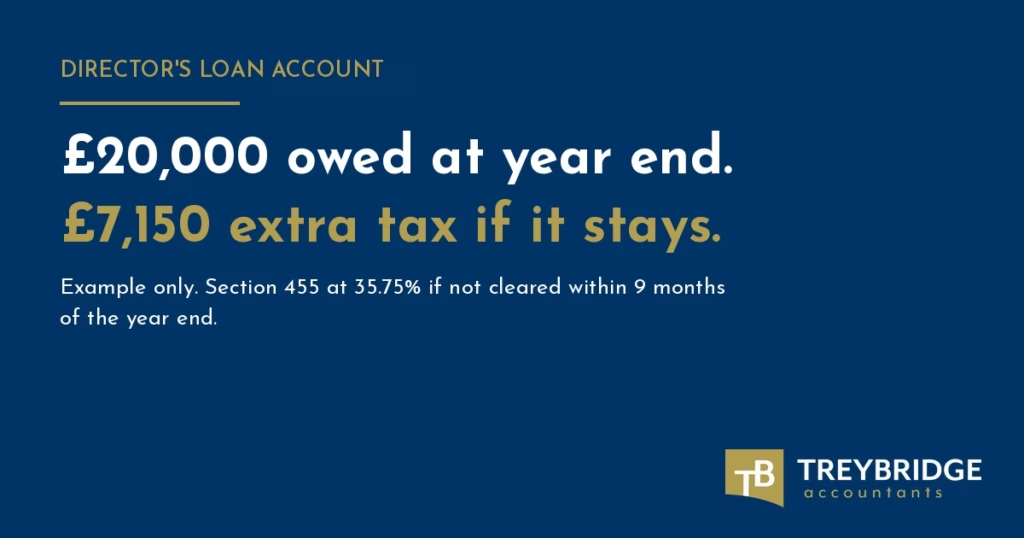
Illustrative numbers only. Your company has a year end of 31 December 2026. During that year, on or after 6 April 2026, you take out a loan of £20,000 that is still outstanding at the year end.
If the £20,000 is not cleared by 30 September 2027, the company owes an extra £7,150 (£20,000 at 35.75%). For most companies, that amount is due on the same date as the Corporation Tax bill, which is 9 months and 1 day after the year end: 1 October 2027.
If you clear the loan in full before 30 September 2027, the company should not have to pay the section 455 charge at all.
You get it back, slowly
Once the loan is repaid, released or written off, the company can reclaim the section 455 tax it has paid. It cannot reclaim any interest HMRC has charged.
The reclaim is not instant. Relief is due 9 months and 1 day after the end of the accounting period in which you cleared the loan, and HMRC will not repay it before that date. The claim normally has to be made within 4 years.
That is cash sitting with HMRC instead of in your business. In some cases, paying the charge and reclaiming it later is still a reasonable choice. It should be a decision you make with your eyes open, not a surprise in the accounts.
Four ways to clear an overdrawn director’s loan
There is no single right answer. The four practical routes are to repay the loan from personal money, to vote a dividend and credit it to the loan account, to pay a bonus through payroll and credit the net amount, or to use a mix of those three. Each one has a different tax cost, and some are not available in every case.
1. Repay it from personal money
If you have the cash, this is the most straightforward route. You pay £20,000 into the company, the loan is cleared, and there is no extra Income Tax, National Insurance or section 455 charge as a result of the repayment itself.
The honest caveat is that the money has to be yours to give back. If the cash left the company in the first place because you needed it, this route may not be realistic, and the other options need to be compared instead.
2. Vote a dividend, if the company has the profits available
A dividend can be credited to your director’s loan account rather than paid out in cash. For section 455 purposes, the loan is treated as repaid when that credit is a real repayment of the debt, properly recorded in the company’s books.
A dividend is only lawful if the company has sufficient distributable profits. If it does not, this route is not available, no matter how tidy it would look. Dividends are not deductible for Corporation Tax, and you pay tax on them at the dividend rates, after the £500 dividend allowance. For the 2026 to 2027 tax year those rates are 10.75% at the basic rate, 35.75% at the higher rate and 39.35% at the additional rate.
You will usually need to report the dividend on a Self Assessment return.
3. Pay a bonus through payroll
A bonus, or other salary, can also be credited to the loan account. The amount that actually clears the loan is the net amount after Income Tax and employee’s National Insurance have been deducted through PAYE. The company also pays employer’s National Insurance, currently 15% above the secondary threshold for a typical category A employee in 2026 to 2027.
Unlike a dividend, a bonus is usually deductible for Corporation Tax, which reduces the net cost to the company. The personal tax cost is often higher than a dividend, because Income Tax and National Insurance are charged on the gross pay. Scottish Income Tax bands and rates are different, so a director who is a Scottish taxpayer will not have the same bonus figures as the examples below.
How salary, dividends and National Insurance fit together is something we look at in more detail when we talk about a tax-efficient director’s salary.
4. Use a mix of the three
Many owners clear part of the balance with a dividend, part with a bonus, and the rest from personal money. That can make sense if, for example, you have some unused basic-rate band, only part of the cash to hand, or only limited distributable profits.
The right mix belongs in a tax plan before the year end, not in a scramble once the accounts are almost finished.
Comparing the tax cost: illustrative numbers
The figures in this section are illustrative only. They use 2026 to 2027 rates for England, Northern Ireland and Wales, and they assume:
- you need to clear a £20,000 overdrawn director’s loan
- your Personal Allowance of £12,570 and the £500 dividend allowance have already been used
- for the higher-rate examples, the extra income sits in the higher-rate band, above £50,270, so employee’s National Insurance on a bonus is 2%
- for the basic-rate examples, the extra income stays in the basic-rate band and below the upper earnings limit, so employee’s National Insurance on a bonus is 8%
- the company is already above the £5,000 secondary threshold, pays employer’s National Insurance at 15%, and is not using Employment Allowance against this bonus
- the bonus is grossed up so that the net pay credited to the loan is £20,000
- the dividend is £20,000, credited to the loan, and you pay the dividend tax from other personal funds
- amounts are rounded to the nearest pound
For a higher-rate taxpayer, with the company paying Corporation Tax at 25%:
| Route | Extra tax (illustrative) | Cash effect |
|---|---|---|
| Repay from personal money | Nil | You pay £20,000 into the company |
| Dividend of £20,000 | £7,150 of dividend tax | No cash goes into the company |
| Bonus leaving £20,000 net | £9,741 of Income Tax and National Insurance, after Corporation Tax relief | The company pays a gross bonus of £34,483 plus £5,172 of employer’s National Insurance, before that relief |
For a basic-rate taxpayer, with the company paying Corporation Tax at 25%:
| Route | Extra tax (illustrative) | Cash effect |
|---|---|---|
| Repay from personal money | Nil | You pay £20,000 into the company |
| Dividend of £20,000 | £2,150 of dividend tax | No cash goes into the company |
| Bonus leaving £20,000 net | £3,959 of Income Tax and National Insurance, after Corporation Tax relief | The company pays a gross bonus of £27,778 plus £4,167 of employer’s National Insurance, before that relief |
A repayment from personal money has no extra tax cost. The cost is simply the £20,000 of your own cash, which the company then holds.
If you are a higher-rate taxpayer and the company pays Corporation Tax at the 25% main rate, a £20,000 dividend costs £7,150 in dividend tax. A bonus that leaves £20,000 net needs a gross amount of £34,483. Income Tax is £13,793, employee’s National Insurance is £690, and employer’s National Insurance is £5,172. After Corporation Tax relief of £9,914, the total extra tax is £9,741. In that situation, the dividend is cheaper than the bonus, provided the company can lawfully pay one.
If you are a basic-rate taxpayer and the company pays Corporation Tax at 25%, a £20,000 dividend costs £2,150. The equivalent bonus needs a gross amount of £27,778, with Income Tax of £5,556, employee’s National Insurance of £2,222 and employer’s National Insurance of £4,167. After Corporation Tax relief of £7,986, the total extra tax is £3,959. The dividend is still cheaper, but the gap is smaller.
The comparison changes if the company pays Corporation Tax at the 19% small profits rate, because the Corporation Tax relief on a bonus is then worth less. For the same higher-rate bonus, the total extra tax rises to £12,121. For the same basic-rate bonus, it rises to £5,875. A director paying additional-rate dividend tax at 39.35% would pay £7,870 on a £20,000 dividend.
None of these figures includes the section 455 charge, because each route is assumed to clear the loan in time. If you do nothing, the company is looking at £7,150 of section 455 tax on this example, which it can later reclaim, slowly, once the loan is cleared.
The cheapest route depends on your tax band, whether a dividend is lawful, whether you have personal cash, and the Corporation Tax rate the company actually pays. It also depends on cash flow. A dividend credited to the loan does not put cash into the company. A personal repayment does. A bonus costs the company more cash up front, even after the Corporation Tax relief.
What does not work: the 30 day rule and the £15,000 arrangements rule
Repaying the loan just before the deadline and taking a similar amount back out soon afterwards does not usually cancel the charge.
If you repay £5,000 or more and, within 30 days, the company lends you £5,000 or more again, HMRC can treat the repayment as clearing the new loan rather than the old one. The section 455 charge can still apply to the original balance. This is the 30 day rule, sometimes called bed and breakfasting.
A second rule catches planned re-borrowing even outside that 30 day window. If the balance is £15,000 or more and, at the time you repay it, arrangements are already in place for you to borrow £5,000 or more again, relief can be restricted. There is no set time limit on that rule.
The repayment has to be real. The money needs to have reached the company, and the books need to reflect what actually happened.
The £10,000 benefit in kind point
Section 455 is not the only tax point on an overdrawn director’s loan account.
If the total balance on beneficial loans, typically an interest-free or low-interest loan from the company, does not exceed £10,000 throughout the tax year, there is no taxable benefit. If the balance goes over £10,000 at any point in the tax year, there may be a benefit in kind to report, even if the loan is later cleared.
The taxable benefit is based on HMRC’s official rate of interest, less any interest you actually pay. The official rate is 3.75% from 6 April 2026. On an illustrative £20,000 interest-free loan outstanding for a full tax year, the cash equivalent is £750 (£20,000 at 3.75%). A higher-rate taxpayer would pay £300 of Income Tax on that benefit. The company would report it on form P11D and pay Class 1A National Insurance on the benefit, at 15% for 2026 to 2027, which is £113 in this example.
That benefit in kind is separate from section 455. You can face both.
If the loan is written off or released rather than repaid, the amount written off is taxed on you as income, and the company has Class 1 National Insurance to account for through payroll. That is rarely a cheap way to tidy the account.
Sometimes paying the charge is the better choice
An overdrawn loan account should not be ignored, but it should not always be cleared at any cost either.
If you cannot repay the loan from personal money, the company does not have distributable profits for a dividend, and a bonus would cost more in tax and cash than the section 455 bill, paying the 35.75% charge and reclaiming it later can be the more sensible option. The downside is that the company’s money sits with HMRC until the reclaim is due, and any interest charged on late payment is not refunded.
The important thing is that this is a planned decision, made before the year end where possible, and reviewed again before the 9 month deadline.
Plan it before the year end, not after
The best time to look at your director’s loan account is while the year is still open, when you can still choose how to take money out of the company, and while there is time to get a dividend or a payroll entry right.
If your year end is 31 December, that conversation belongs in the autumn, not the following September. Monthly management accounts make the balance visible in time to act. A year-end only view often leaves you with fewer good options.
If you would like a plain-English review of your own figures, we are happy to help. We work with owner-managed businesses across the UK and Ireland from our office at C4DI in Hull.
Book a free call
If you want to talk through an overdrawn director’s loan account before your year end, book a free discovery call, call 01482 235575, or email [email protected]. You can also get in touch here or read the questions owners ask us most.
This article is general information, not personal tax advice. The figures are taken from gov.uk as at 23 November 2026 and can change. The right way to clear a director’s loan depends on your own circumstances, including your tax band, your company’s profits and the lawfulness of any dividend.
Overdrawn director’s loan accounts: your questions answered
What is an overdrawn director’s loan account?
It is a running record showing that you owe your limited company money. It usually arises where you have taken money out that was not salary, not a dividend and not a business expense. If the balance is cleared in time, it need not lead to a section 455 charge.
What is the section 455 tax rate for loans made from 6 April 2026?
The rate is 35.75% for loans made from 6 April 2026. It follows the dividend upper rate for the tax year in which the loan is made. Loans made from 6 April 2022 to 5 April 2026 are still charged at 33.75%. The charge is paid by the company, not by you personally.
When do I have to clear an overdrawn director’s loan to avoid the charge?
You need to clear it within 9 months of the end of the accounting period in which the loan was made. For a 31 December 2026 year end, that deadline is 30 September 2027. If the charge does become payable, it is usually due on the same date as the company’s Corporation Tax, which for most companies is 9 months and 1 day after the year end.
Can I repay a director’s loan with a dividend?
Yes, if the company has sufficient distributable profits to vote a lawful dividend, and the dividend is properly credited so that it actually clears the debt. A dividend is not deductible for Corporation Tax, and you will usually pay dividend tax on it. If the company does not have the profits, this route is not available.
Is an overdrawn director’s loan a benefit in kind?
It can be, if it is interest-free or charged below HMRC’s official rate and the total balance on beneficial loans goes over £10,000 at any point in the tax year. The benefit is based on the official rate, which is 3.75% from 6 April 2026, less any interest you pay. It is separate from the section 455 charge.
What happens if I repay the loan and then borrow it back?
If you repay £5,000 or more and borrow £5,000 or more again within 30 days, HMRC can treat the repayment as not clearing the original loan. If the balance is £15,000 or more and arrangements are already in place to borrow £5,000 or more again, relief can also be restricted, even outside that 30 day window.
If the company pays the 35.75% charge, can it get the money back?
Yes. Once the loan is repaid, released or written off, the company can reclaim the section 455 tax. The reclaim is due 9 months and 1 day after the end of the accounting period in which the loan was cleared, and any interest charged is not refunded. In some cases, paying the charge and reclaiming it later is a reasonable choice.
Do these rules apply to companies in Ireland?
Section 455 is a UK Corporation Tax charge on UK close companies. It does not apply to an Irish company in the same way. If you have companies or income in both the UK and Ireland, the position needs to be looked at under the rules that actually apply to each company.